
AI tools for developers in December 2025 are transforming how coding, testing, and deployment are done. Key updates include:
These advancements make AI indispensable for developers, streamlining workflows and tackling complex tasks efficiently.
AI-powered code assistants continue to evolve, bringing updates designed to simplify and enhance the development process.
GitHub Copilot has rolled out updates as of December 2025, focusing on improving its integration within development environments. While specific features haven’t been detailed yet, developers can expect smoother in-editor assistance, making coding workflows more efficient. Additionally, advancements in code review and collaboration are being introduced across similar tools.
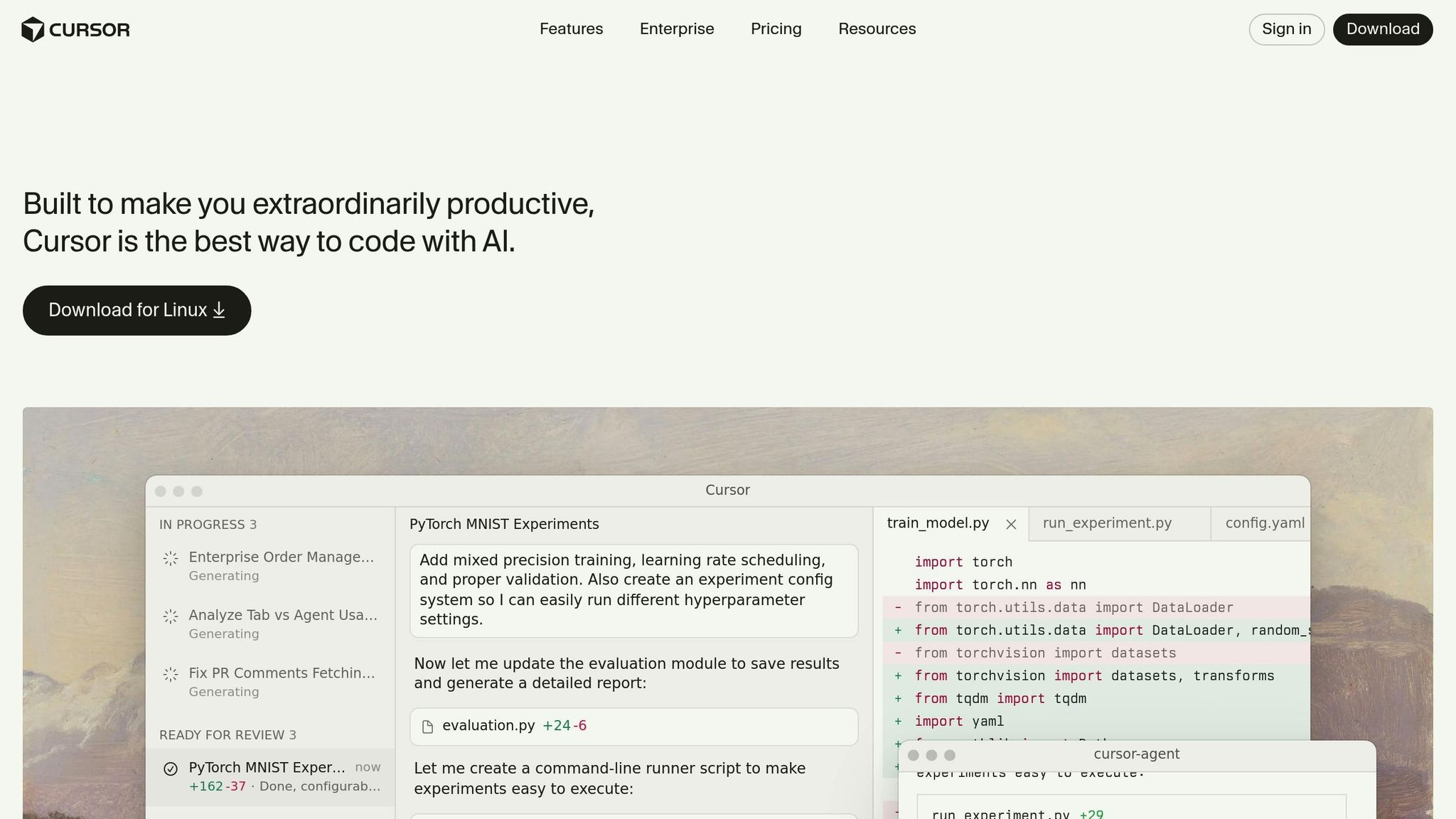
Cursor has introduced updates aimed at improving code review and collaboration. These updates include better contextual guidance during code reviews, helping developers address issues and refine their code more effectively.
Several other AI tools are also stepping up their game. They now offer expanded language support, safer code configuration options, and improved refactoring capabilities. Some tools even allow organizations to train custom models locally, providing solutions that prioritize data privacy and security.
Autonomous coding agents are designed to handle entire development tasks on their own, managing everything from analysis and coding to testing and debugging - all without needing constant input from a human developer.
While traditional tools like GitHub Copilot are great for offering code suggestions and autocompleting snippets, autonomous coding agents take things to the next level. Instead of just assisting with parts of the process, they handle entire assignments from start to finish.
Here’s how they work: these agents can analyze project requirements, write the necessary code, run tests, identify bugs, and fix them. Think of them as junior developers capable of working independently. You provide a task - like "add user authentication to this API" or "refactor this module to improve performance" - and the agent figures out how to make it happen.
Unlike standard code assistants that wait for you to start typing, autonomous agents take a task description and execute it with minimal oversight. Their capabilities extend across multiple areas, including debugging existing code, running diagnostics, and applying fixes. They can also generate unit tests, integration tests, or other test types tailored to the codebase. Additionally, they can refactor outdated code, update dependencies, and even migrate code between frameworks.

Several standout autonomous coding agents showcase different approaches to independent development.
These tools vary in how they integrate with development environments and their pricing models. Some work as standalone platforms, while others seamlessly connect to existing workflows. The level of autonomy also differs - some agents require user approval before making changes, while others operate more freely within set boundaries.
Beyond task execution, these agents can also modernize legacy systems, manage dependencies, and generate documentation. This allows developers to focus on higher-level tasks like architectural design and system strategy, while the agents streamline maintenance and updates.
The latest updates to ChatGPT, Claude, and Gemini bring better code handling, smoother performance, and more flexible integration options for developers.
Here’s what’s new with each platform:
OpenAI has introduced improved external tool integration and coding customization. These changes make it easier to incorporate AI into development workflows, simplifying tasks like embedding and automation.
Anthropic has upgraded Claude to handle technical challenges more effectively. The updates include enhanced code review and debugging capabilities, helping developers diagnose issues and prototype faster.
Google’s Gemini now supports a broader range of programming languages and offers deeper cloud integration. New features also include refined code analysis and automated documentation generation, making it a more comprehensive tool for developers.
These updates highlight how AI platforms are evolving to address the practical needs of developers, offering tools that improve efficiency and expand possibilities.
AI is no longer limited to general-purpose tools. Today, specialized solutions tackle focused development challenges like identifying security vulnerabilities and ensuring top-notch code quality. These tools integrate seamlessly into existing workflows, expanding AI's role to address specific needs within the development process.
Here’s a closer look at a few tools that focus on niche areas like security, natural language processing (NLP), and improving productivity in integrated development environments (IDEs).
Snyk Code leverages AI alongside a curated vulnerability database to identify security flaws in real time. It scans for issues like SQL injections, cross-site scripting (XSS), and outdated libraries, offering immediate alerts directly within popular IDEs like VS Code and JetBrains. What sets Snyk Code apart is its ability to explain the root cause of vulnerabilities while providing actionable fixes.
The tool also integrates with CI/CD pipelines, automating security checks for every commit or pull request. This proactive approach - often called "shift left" - helps teams catch issues early in development, which is especially important for industries like finance and healthcare that require strict compliance and efficient collaboration [1].
There were no updates reported for Hugging Face Transformers in December 2025.
JetBrains AI Assistant, which supports tasks like code analysis and testing, had no new updates announced for December 2025.
By December 2025, AI tools had taken significant strides, evolving from simple code assistants to autonomous agents capable of managing complex, multi-step tasks. Language models like ChatGPT, Claude, and Gemini introduced features tailored for developers, while tools like Devin AI and Manus AI redefined what AI could achieve by executing entire tasks, not just offering suggestions. These advancements have shifted AI from being a novelty to an essential part of a developer’s toolkit, supporting teams of all sizes and specialties with greater precision and efficiency.
This progression signals a pivotal moment in development. The advancements in code assistance and autonomous agents highlight how deeply AI is embedding itself into daily workflows. As we look toward 2026, the conversation is no longer about whether to use AI but about how to best integrate it into existing processes. From security to code reviews to feature development, there's likely an AI tool ready to simplify and optimize at least part of your workflow.
Autonomous coding tools such as Devin AI, Qodo, and Manus AI each bring their own strengths to the table, catering to different aspects of the development process. Devin AI focuses on reducing the burden of repetitive coding tasks while prioritizing code quality and optimization. This makes it a great choice for developers aiming to streamline routine work without compromising on performance.
Qodo, on the other hand, shines in enhancing productivity through real-time collaboration and task management features. Its workflow-oriented design is ideal for teams looking to stay organized and work seamlessly together.
For more advanced needs, Manus AI steps in as a powerful ally. It excels at generating complex code structures and offers robust debugging support, making it particularly valuable for tackling intricate development challenges.
Each of these tools addresses specific developer pain points, giving teams the flexibility to select the one that aligns best with their project requirements and objectives.
The December 2025 update for GitHub Copilot brings a range of improvements designed to make code reviews more efficient and seamlessly fit into development workflows. Here’s what’s new: more precise contextual suggestions during pull requests, smarter detection of code patterns to deliver tailored recommendations, and deeper integration with widely-used IDEs for a smoother, more intuitive coding process.
On top of that, collaboration gets a boost with clearer, more accurate explanations for suggested code changes. This makes it easier for teams to understand, review, and implement updates effectively. These enhancements aim to help developers work more quickly while maintaining confidence in the quality of their code.
AI-powered tools such as Snyk Code are built to fit seamlessly into the development process, allowing developers to spot and resolve security vulnerabilities directly in their code. These tools are compatible with widely-used IDEs, CI/CD pipelines, and version control systems, ensuring they blend effortlessly into your workflow without causing interruptions.
By automating code analysis and delivering real-time, actionable feedback, Snyk Code enhances both security and efficiency. Developers can tackle issues early in the development cycle, cutting down on rework and paving the way for safer, more dependable software.
Let's level up your business together.
Our friendly team would love to hear from you.


