
Generative AI is transforming how apps interact with users by creating tailored experiences. Unlike traditional methods, it dynamically generates content such as onboarding flows, notifications, and recommendations based on user behavior and preferences. This approach increases engagement, reduces churn, and boosts revenue.
To implement this, businesses need clean behavioral data, robust infrastructure (e.g., AWS), and privacy compliance. Starting small, such as piloting with onboarding or recommendations, can help refine the approach before scaling. Partnering with experts like Octaria ensures smooth integration and adherence to best practices for security and governance.
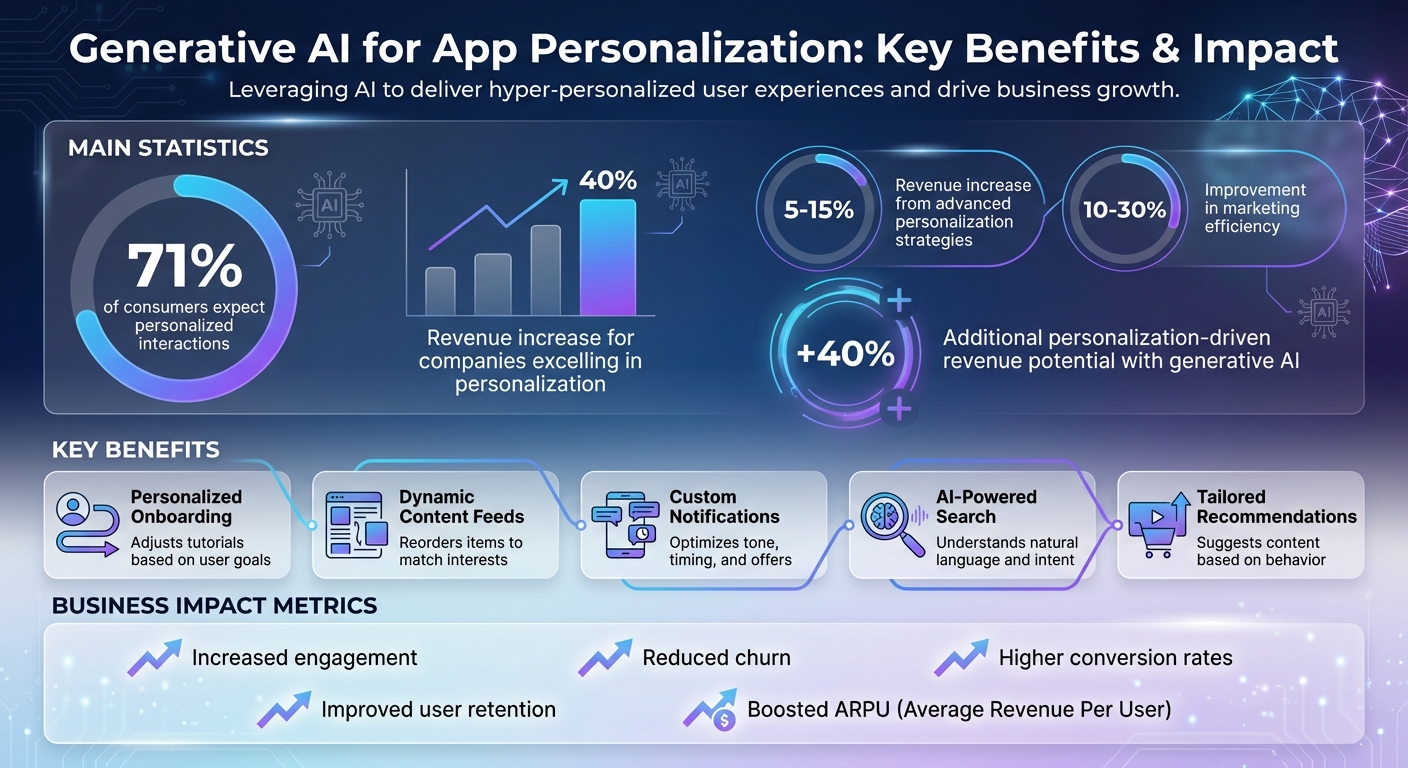
Generative AI App Personalization: Key Benefits and ROI Statistics
Generative AI personalization brings together various AI systems to create tailored user experiences. Large Language Models (LLMs), such as GPT-4, are at the forefront, crafting personalized content like push notifications, in-app messages, and onboarding copy. These models adjust the tone, level of detail, and messaging based on user behavior and preferences, making the content feel relevant and engaging rather than one-size-fits-all[1][2].
Multimodal models take this a step further by generating both text and images simultaneously, expanding the scope of personalization. Meanwhile, traditional recommendation engines - whether using collaborative filtering, content-based methods, or hybrid approaches - determine what content to show users by analyzing behavioral patterns[3][5]. Reinforcement learning models then refine these decisions in real time, learning from user interactions like clicks and conversions to improve the performance of content, layouts, and offers[5].
The most effective personalization strategies combine these technologies. For example, recommendation engines identify relevant products or content and then hand off that context to LLMs, which craft individualized messages for each user[3]. This combination ensures that both the content and how it’s presented feel tailored to the individual.
Personalization starts with accurate and comprehensive data. First-party behavioral data is the foundation, encompassing user interaction logs, browsing history, purchase patterns, session durations, feature usage, demographics, preferences, device types, locations, and time zones[4][5]. Without this clean and detailed data, AI models lack the context needed to create meaningful personalization.
Content metadata is just as important. Detailed product descriptions, titles, categories, and attributes enable AI to generate more precise and engaging personalized content variants[3]. Real-time event streaming also plays a crucial role, allowing systems to respond instantly to user actions - like sending adaptive notifications based on current behavior rather than relying solely on historical data[4]. Additionally, performance data from previous personalization efforts - such as which email formats or message styles resonated most with specific user segments - helps train models to improve output over time[1].
For businesses looking to scale personalization efforts, robust infrastructure is essential. Many U.S. companies turn to AWS-hosted models for managed solutions that reduce operational complexity and offer automatic scaling. AWS also provides pre-configured LangChain code, simplifying the integration of recommendation engines with generative AI models[3].
Real-time personalization requires low latency, and vector databases are a key component. They enable fast similarity searches, which recommendation engines use before passing results to generative AI models for content creation[3]. A hybrid approach is common: businesses use managed cloud services for complex tasks like content generation, while relying on edge caching and local processing to minimize latency for time-sensitive interactions, such as push notifications and in-app messages[4]. Orchestration tools ensure smooth workflows between recommendation engines and content generation models, keeping data flowing efficiently through the system[3].
With this infrastructure in place, safeguarding user data becomes a top priority.
For U.S.-based companies, managing user data responsibly is critical. Personally Identifiable Information (PII) - including names, email addresses, location data, and behavioral patterns - must be handled with care. Data minimization is key: collect only what’s necessary and retain it for as short a time as possible. State laws like California’s CCPA and Virginia’s VCDPA require explicit user consent for data collection and processing. These laws also grant users the right to access, delete, and opt out of personalized experiences[6].
To ensure data security, all user information should be encrypted both in transit and at rest. Access controls should limit who can view sensitive data. If third-party AI services or cloud providers are involved, confirm they have appropriate data processing agreements and that customer data won’t be used to train public AI models[7]. Transparency is equally important - privacy policies should clearly explain how AI analyzes user behavior to create personalized experiences. Companies working with AWS implementation specialists must also verify that their vendors meet these compliance standards and can provide documentation of their security practices.
Generative AI is reshaping how apps personalize user experiences, offering tailored interactions that feel intuitive and engaging.
Generative AI can make onboarding smoother by analyzing user data - like profiles, preferences, and initial behaviors - and adjusting content and interface elements in real time. For instance, a financial app might skip basic investment tips for experienced traders while offering step-by-step guidance for beginners. It can also localize user flows by adapting language, visuals, and compliance notices based on regional or demographic needs, all without requiring manual updates.
Take Zalando's "Trend Spotter" feature as an example. In 2023, the company used generative AI to craft region-specific onboarding content. By analyzing signals like cart activity and search behavior, it tailored messaging to individual cities, creating a more relevant experience that boosted both activation and retention rates. The system also learned from drop-off points and successful sign-ups, continuously evolving to minimize user friction [8].
Generative AI takes content personalization to the next level by combining collaborative filtering with semantic analysis. It doesn't just look at user behavior but also considers factors like style, sentiment, and topics to deliver recommendations that feel timely and relevant. For example, it can generate contextual labels such as "because you watched…" or "inspired by your recent hikes", which not only personalize the experience but also build trust.
Amazon Personalize is a great example of this in action. It creates batch recommendations with themed descriptions - like "Rise and Shine" for someone who frequently shops for breakfast items - boosting revenue and marketing efficiency. According to McKinsey, advanced personalization strategies can increase revenue by 5–15% and improve marketing efficiency by 10–30%. Generative AI could add another 40% to personalization-driven revenue by keeping recommendations fresh through real-time signals such as scroll depth, skips, and watch time [9].
Generative AI also enhances user engagement through smarter notifications. By analyzing behavior, it can determine the best tone, timing, and channel for push notifications. Instead of sending generic messages, AI crafts personalized ones - for example, using urgent language to appeal to deal-seekers or a softer tone for brand-loyal customers.
Apps can use this technology to address specific events like cart abandonment or subscription renewals, generating tailored messages with the right incentives. Companies like Spotify and Netflix already leverage AI-driven notifications to boost re-engagement and retention. These systems are continually refined through A/B testing, focusing on metrics like click-through and conversion rates.
Search functionality gets a major upgrade with generative AI, moving beyond simple keyword matching to understand user intent. This means users can type conversational queries - like "podcasts to help me fall asleep quickly" - and still get accurate results, even if their phrasing doesn’t match exact keywords. Chatbots powered by generative AI can also provide personalized recommendations through conversational interfaces.
This is made possible through content embeddings, which map users and content into a shared vector space for precise matching. Generative AI enhances search by delivering summarized answers alongside links to FAQs, product pages, or support sections, enabling better self-service. It also refines rankings based on user history, price preferences, or favorite brands, often adding helpful explanations like "top picks in your usual price range." These advancements showcase how generative AI is transforming app interactions across the board.
This framework outlines how to integrate generative AI into personalized app experiences, building on the potential of AI technologies.
Start by identifying one to three key business objectives - like increasing Day 30 retention from 25% to 32%, boosting checkout conversion from 3.5% to 4.5%, or raising monthly ARPU from $7.50 to $9.00. Tie these goals directly to measurable KPIs. Segment the KPIs by user cohorts (e.g., new vs. returning users, regions within the U.S., or platforms such as iOS, Android, or web) to pinpoint where personalization could make the biggest difference.
Trace the user journey from acquisition to retention, noting where users drop off or encounter generic experiences. Examples of high-impact use cases include personalized onboarding that skips redundant steps, home feeds ranked by predicted interests, and push notifications that adapt to user behavior. Use an impact–effort matrix to prioritize opportunities by potential KPI improvement, technical complexity, and data readiness. Focus first on use cases that impact a large audience, have clear metrics for success, and use data your app already collects - like clicks, views, or purchases.
"Most dev shops follow instructions. Our Pods lead solutions." – Octaria [10]
"They analyze your business problems and find smart, tailored solutions - not just code, but business clarity." – Ryan Moore, PiggyBack Cabling [10]
Begin with a pilot focused on one part of the user journey, such as onboarding or paywalls, and set a single "north star" KPI, like trial start rate. Support this with secondary metrics like session length or user satisfaction. Octaria, a Houston-based software development company, excels at defining strategies that align generative AI personalization with critical business goals, ensuring clarity in what to build and why.
Once goals are set, ensure your data and infrastructure are ready to support personalization.
Generative AI personalization relies on three types of data: behavioral, contextual, and content. Behavioral data includes user actions like app opens, clicks, searches, purchases (in USD), and subscription changes, all timestamped and linked to unique user IDs. Contextual data captures details such as device type, operating system, location (city or regional level, in line with U.S. privacy norms), and traffic sources. Content data describes the items being recommended, including titles, tags, and categories.
Create a standardized event schema with clear naming conventions (e.g., item_viewed, item_purchased), required properties (like item_id and price in USD), and consistent units. Document this schema thoroughly and validate events in both staging and production environments to ensure data reliability for training models and retrieval-augmented generation (RAG) pipelines.
Adopt an AWS-based architecture that ingests event data, stores it in durable storage (e.g., Amazon S3), and uses tools like Amazon Redshift to clean, transform, and prepare data for recommendation systems. For RAG, index content and metadata in vector databases for efficient retrieval. At query time, the app combines user profiles, recent behaviors, and explicit queries to fetch relevant documents. This context is then fed into a generative model to produce personalized outputs. APIs or microservices manage tasks like authentication, rate limiting, and observability. Octaria specializes in modernizing and scaling systems for businesses looking to deploy AI-driven solutions.
With data in place, the next step is selecting models that align with your goals.
Choose models based on task type, latency, cost, data sensitivity, and the level of control you need. For text-based tasks like generating messages or recommendations, transformer-based large language models are often the best choice.
When selecting a model, consider factors like domain-specific quality, response time (ideally under a few hundred milliseconds for smooth user experiences), scalability during peak U.S. traffic, and pricing structures. For industries like healthcare or finance, where sensitive data is involved, deploying models within a VPC with strict network controls may be necessary.
Implementing RAG involves choosing the right content sources - like product catalogs, FAQs, or user-generated content - and breaking these into smaller, metadata-rich documents. At query time, the system retrieves the most relevant documents based on user profiles, recent actions, and explicit inputs. This context is then used to generate personalized content. Logging each RAG call with anonymized user IDs, query types, and performance metrics is essential for refining retrieval and prompting strategies over time.
Run controlled experiments to compare the generative AI interface with a rules-based version. Assign users randomly to each version over a fixed period to gather meaningful data. Track metrics like click-through rates (CTR) for personalized content, engagement with push notifications, conversion rates, ARPU, and average order value (AOV). Monitor downstream effects, such as changes in churn rates or customer support tickets.
Collect qualitative feedback through user satisfaction scores, app store reviews, and direct comments on AI-generated content. Ensure sample sizes are large enough, account for seasonal trends (like U.S. holiday shopping), and set clear success thresholds (e.g., a 5% lift in CTR or statistically significant ARPU improvements). Continuously adjust prompts, recommendation parameters, and UI placements based on feedback to improve performance.
Gather both implicit feedback (e.g., clicks, hides, or uninstalls) and explicit feedback (e.g., thumbs up/down). For high-stakes outputs like financial offers or healthcare advice, implement a human review process to ensure quality. Use decisions from these reviews as labeled data to refine models. Track instances of low-quality or off-topic outputs and use them to update prompts or adjust filters. These feedback loops help fine-tune the system, ensuring it evolves effectively.
When deciding between hosted and self-hosted models, consider your app's needs. Hosted models like AWS Bedrock are great for quick prototyping and moderate scaling, offering pay-per-use pricing and managed infrastructure. On the other hand, self-hosted models (e.g., on EC2 or SageMaker) require a higher upfront investment but provide full control over tuning and inference pipelines - ideal for regulated industries. Weigh factors like cost, control, scalability, and security to determine the best fit for your deployment. As you scale, governance, ethics, and compliance will play an increasingly important role in shaping your approach.
Transparency is key when it comes to personalization. Clearly label AI-driven content, such as: "Recommended due to your viewing history." Let users have control over their experience by providing options to adjust personalization settings, manage notification preferences, and opt out entirely if they choose. This way, personalization feels helpful, not intrusive.
Avoid manipulative practices like pre-checked boxes for data sharing, fake urgency tactics, or prompts designed to guilt users into action. Instead, design experiments that balance business goals - like improving conversion rates - with user experience metrics, such as Net Promoter Scores or unsubscribe rates. For instance, timing upsell offers around user milestones and presenting them as tools to achieve their goals can build trust and encourage long-term engagement.
In the U.S., apps must adhere to privacy laws like the CPRA and follow FTC guidelines on AI transparency. This means collecting only the data necessary for specific personalization goals (data minimization) and ensuring robust security measures. Encrypt data during transmission (TLS 1.2+) and while stored (AES-256), enforce strict access controls with least-privilege IAM roles, and use tools like AWS CloudTrail to monitor for suspicious activity.
Set clear retention policies, such as deleting detailed logs after 90 days while retaining anonymized, aggregated statistics for analysis. Techniques like hashing can anonymize data, and sensitive information - like health details or precise geolocation - should only be used with clear justification and explicit user consent. Regular assessments of data protection practices and thorough documentation of data flows help teams stay ahead of legal requirements while fostering user confidence.
Generative AI systems often reflect biases in their training data, which can lead to outputs that exclude or stereotype certain groups. To counteract this, implement a bias evaluation process that examines outputs across factors like age, gender, race and ethnicity proxies, disability needs, and income indicators. Use both quantitative metrics - such as the diversity of recommendations or performance parity (e.g., click-through rates across user segments) - and qualitative reviews by inclusivity-trained auditors.
Prompt templates should be designed to avoid hateful, stereotypical, or exclusionary language, promoting neutral and inclusive phrasing instead. Conduct fairness checks before major updates and monitor post-launch metrics, such as churn rates or user complaints, to identify and address any disparities. Documenting known limitations and mitigation strategies in model cards ensures transparency and accountability over time. These efforts help personalization remain fair and trustworthy.
Scaling personalization responsibly requires a solid governance framework. Octaria, a Houston-based software development firm, specializes in creating AWS-based personalization systems with strong security foundations. They assist U.S. businesses in implementing policy-driven content filters, brand guardrails, and MLOps pipelines for consistent monitoring and quick rollbacks when needed.
Octaria also offers fractional CTO and product manager services, providing businesses with the strategic guidance and technical expertise needed to align their personalization efforts with regulatory requirements and governance standards. With their deep knowledge of AWS, AI systems, and digital transformation, Octaria is a dependable partner for companies aiming to scale personalization responsibly while maintaining compliance, fairness, and user trust over time.
Generative AI personalization transforms static apps into dynamic platforms that respond to individual user behavior and context. By customizing features like onboarding flows, content feeds, notifications, and search results, teams can significantly boost engagement, improve conversion rates, and enhance user retention. Apps that embrace AI-driven personalization often see longer session durations, higher in-app purchases, and lower churn rates - leading to increases in monthly active users, average revenue per user (ARPU), and subscription upgrades.
To implement this transformation, follow a clear roadmap: start by defining specific goals and use cases (focus on one or two impactful areas like onboarding or recommendations), consolidate behavioral and event data on a scalable AWS platform, and choose models that balance latency, cost, and data sensitivity. Next, integrate AI into core app experiences and continuously refine through A/B testing and feature flags. Beginning with small, focused pilots - measuring metrics like activation rates, weekly active users, or incremental revenue - helps minimize risk while building confidence to scale.
For personalization to succeed, ongoing governance, privacy measures, and bias management are essential. U.S. companies should prioritize user consent, create preference centers, and enforce strong security protocols. Monitoring model outputs ensures fairness across user segments. While modern tools make it easier for marketers and product teams to configure prompts and content without deep machine learning expertise, a solid architecture with effective guardrails is crucial to ensure personalization remains both useful and respectful.
Expert partners like Octaria can make this journey smoother. Based in Houston, Octaria specializes in building AWS-powered personalization systems with a strong focus on security and governance. Acting as an embedded CTO and product partner, they assist businesses in designing end-to-end solutions, from data pipelines and model integration to A/B testing frameworks. Their expertise spans custom software, mobile and web apps, and AI implementation, helping teams move from experimentation to large-scale production while maintaining best practices for privacy, performance, and model monitoring.
To get started, identify one app feature - such as onboarding, recommendations, or notifications - that could benefit from personalization. Scope a small pilot with clear goals, assess your data and infrastructure readiness, and create a 60–90 day plan to launch your first generative AI-powered personalization project. It’s a practical first step toward delivering a truly personalized app experience.
Generative AI is reshaping app personalization by delivering real-time, highly customized content and experiences. Unlike older methods that depend on fixed rules or static datasets, this technology uses advanced machine learning to continuously analyze user behavior, preferences, and context. The result? Apps that can adapt and respond in ways that feel more relevant and personal.
Take personalized messages, for instance - generative AI can craft them to fit an individual’s interests or suggest content tailored to their unique tastes. It can even design user interfaces that match someone’s preferences, creating a more seamless experience. By incorporating these features, businesses can boost user engagement and satisfaction, making their apps feel intuitive and centered around the user.
Implementing generative AI into apps demands a solid foundation of infrastructure and top-notch data. On the infrastructure side, you’ll need access to scalable cloud computing platforms (like AWS), as well as GPUs or TPUs to handle model training and inference processes. Reliable storage systems are also crucial for managing and organizing your datasets effectively.
When it comes to data, the focus should be on using clean, varied, and well-labeled datasets that align with your app’s objectives. Generative AI heavily depends on quality input to deliver accurate and tailored results. It’s equally important to ensure your data complies with privacy regulations, such as GDPR or CCPA, to safeguard user information.
With the right mix of infrastructure and data, generative AI can elevate app personalization and create richer user experiences.
Businesses can protect privacy and stay compliant by adopting strong data protection measures and following the appropriate regulations. Start by implementing secure data handling protocols to protect sensitive information and ensure only authorized personnel have access. When training AI models, use anonymized or aggregated data to avoid exposing personal details.
To maintain compliance, follow regulations like GDPR, CCPA, or any other rules relevant to your location. Conduct regular system audits to spot potential vulnerabilities, and foster transparency by clearly explaining to users how their data is being utilized. Collaborating with experts, such as Octaria, can simplify the compliance process and help you integrate secure, scalable AI solutions designed specifically for your business.
Let's level up your business together.
Our friendly team would love to hear from you.


